Independent · not SAM.gov
Small business set-asides, explained
Updated September 2026
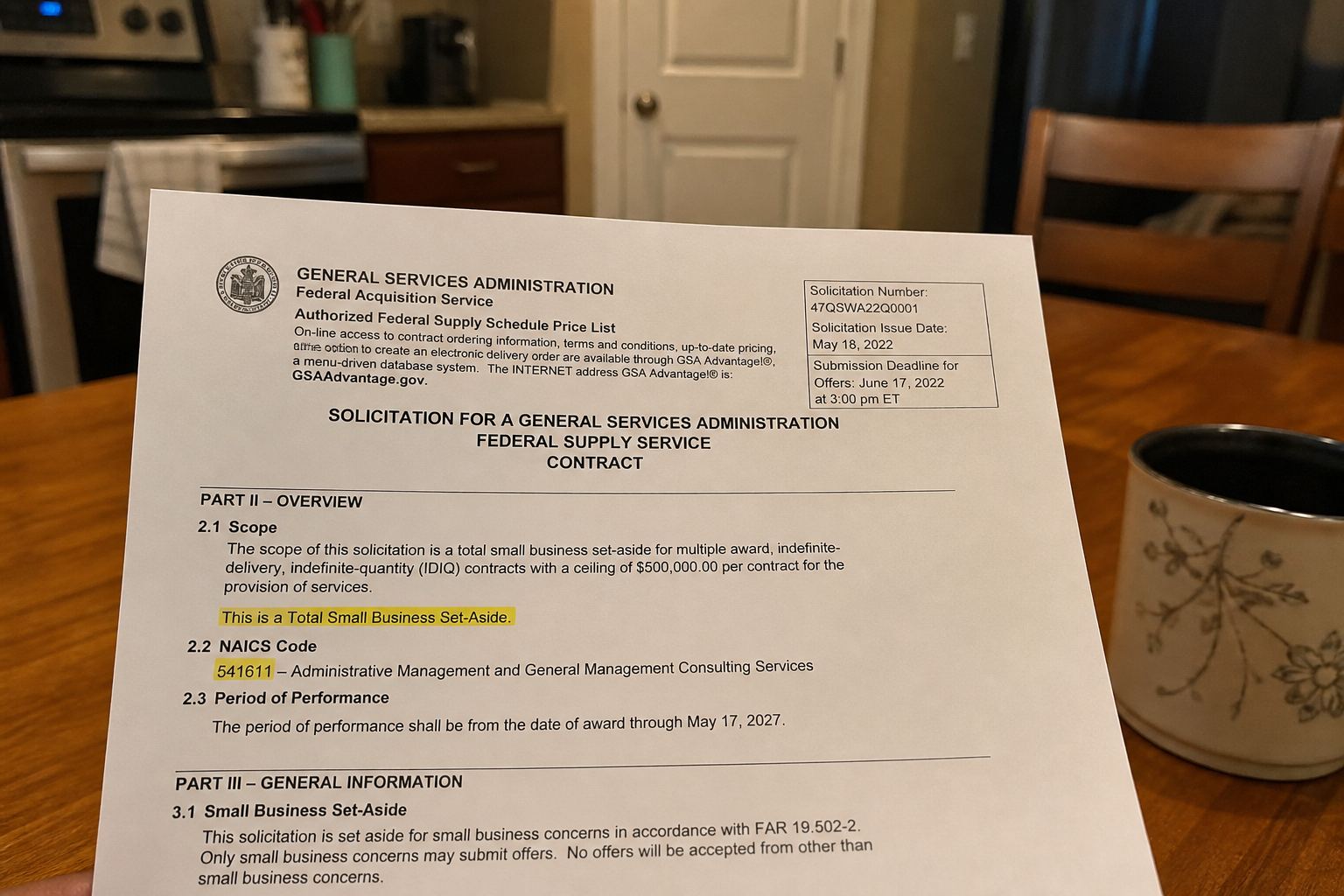
Before you build a proposal around a set-aside category, spend five minutes confirming you actually qualify for it. Contracting officers check eligibility against SBA's own records, not your description of yourself, and finding out you don't qualify after you've already bid costs a lot more than five minutes.
Set-asides exist to keep a real share of federal spending inside small business hands instead of defaulting to the largest, most established contractors every time. The idea is simple. The four programs behind it are not identical, and mixing them up wastes effort on an opportunity you were never eligible for. Here's what actually separates them, and the rule that has to be satisfied before any of them apply.
The rule of two comes first
Before a contracting officer can set aside a contract for small business competition at all, one condition has to be met: there has to be a reasonable expectation that at least two qualified small businesses will submit competitive offers. That's the Rule of Two, and every category below sits behind it. No reasonable expectation of two qualified bidders, no set-aside, regardless of which certification you're holding.
The 2026 FAR overhaul changed a lot about procurement paperwork, and separate 2026 changes raised some compliance thresholds, both covered in our plain-English rundown of that overhaul, but the Rule of Two came through it intact. Set-asides weren't part of what got simplified away.
Registration comes before certification
None of the four programs below replace basic SAM.gov registration. You still need a Unique Entity ID, you still self-certify your business size under Representations and Certifications, and none of it costs anything to do yourself. If that part isn't done yet, our SAM.gov registration checklist covers what to have ready before you start. Set-aside certification is additional work on top of registration, not a substitute for it. The size line itself may move soon: SBA's proposed new size standards would raise most of them, which would change who competes for a set-aside.
8(a) Business Development Program
The 8(a) program is for owners who are socially and economically disadvantaged, and it's structured differently from the other three categories: it's a nine-year program with distinct stages, not a certification you get once and keep forever. The earlier stages generally come with more development and mentorship support, and the program pushes toward operating independently by the later years. It also opens the door to sole-source awards under certain dollar thresholds, on top of set-aside competition. The other programs have sole-source authority too, each with its own conditions: a WOSB or EDWOSB award, for example, can be sole-sourced only when two or more eligible firms are not expected to bid and the price stays at or under $7 million for manufacturing or $4.5 million otherwise (13 CFR 127.503). The way new applicants prove social disadvantage changed on September 10, 2026; our explainer on the new 8(a) social disadvantage rule covers the evidence SBA now asks for. The separate DBE program for DOT-funded highway, transit and airport work dropped its presumptions too, and it does not carry 8(a) status over automatically; see DOT's final DBE rule.
WOSB and EDWOSB
Women-Owned Small Business (WOSB) status applies to a business that's at least 51% unconditionally and directly owned and controlled by one or more women who are US citizens and live in the United States (13 CFR 127.200). Economically Disadvantaged WOSB (EDWOSB) is a narrower slice of that same group, with additional economic disadvantage requirements layered on top. The distinction is more than paperwork: some contracts are set aside specifically for EDWOSB firms rather than WOSB firms generally, so knowing which category you actually fall into changes which opportunities you can pursue.
Two limits catch people out. These set-asides exist only in industries SBA has designated as underrepresented, so check your NAICS code against SBA's eligible list first. And to win one you need to be certified (SBA says there is no cost to apply to it directly); a woman-owned firm that only self-certifies in SAM.gov still counts toward agency goals but cannot take a WOSB or EDWOSB set-aside or sole-source award.
SDVOSB
Service-Disabled Veteran-Owned Small Business (SDVOSB) status requires at least 51% ownership and control by one or more veterans with a service-connected disability. That's a specific standard, tied to a VA disability determination, not to veteran status by itself. A veteran without a service-connected disability rating doesn't qualify here, even if they'd otherwise be considered veteran-owned under a broader, informal definition.
HUBZone
Historically Underutilized Business Zone (HUBZone) status works differently from the other three: it's tied to geography and employment, not primarily to who owns the business. Your principal office generally has to sit inside a designated HUBZone area, and a meaningful share of your employees generally have to live in one too. Ownership requirements exist as well, but location and employee residency are what actually set this category apart. Designated zones shift over time, so check the current map rather than assume an old answer still holds. Our guide to HUBZone certification covers the 35% rule, who counts as an employee and what the 2026 map changes mean.
Side by side
| Program | Core eligibility | What sets it apart |
|---|---|---|
| 8(a) | Socially and economically disadvantaged ownership | Nine-year staged program; can include sole-source awards |
| WOSB | At least 51% directly owned and controlled by women who are US citizens | Set-asides for certified firms, only in SBA-designated industries |
| EDWOSB | WOSB criteria plus added economic disadvantage requirements | Narrower category; some contracts reserved for EDWOSB specifically |
| SDVOSB | At least 51% owned by veteran(s) with a service-connected disability | Tied to a VA disability determination, not veteran status alone |
| HUBZone | Principal office in a designated zone, plus employee residency and ownership rules | The only category built around location, not ownership identity |
A business can hold more than one of these certifications at once if it genuinely meets the criteria for each. A woman veteran running a company in a designated zone isn't forced to pick a single lane.
No past contracts yet? You can still compete
This is a real, common worry, and it deserves a straight answer instead of a brush-off. A lack of prior federal contracts is not, by itself, disqualifying. Contracting officers can weigh other things instead, including:
- Related non-federal experience. Commercial contracts in the same line of work can count toward showing you can do the job.
- Subcontract history. Work performed as a subcontractor on a federal prime contract is still relevant experience, even without a prime contract of your own.
- Program-specific support. 8(a), for example, is built with newer entrants in mind, with structured mentorship built into the earlier stages.
None of this is a guarantee. Set-aside status doesn't erase the need to show you can do the work, it just means the door isn't closed the moment you've never held a federal contract before.
Keep it current
Each of these certifications sits on top of a SAM.gov registration that has to be renewed every year, and an expired registration makes you ineligible for new awards until it's fixed, set-aside status or not. Federal work also carries risks that have nothing to do with certification, like funding gaps during a lapse in appropriations; our page on what a shutdown actually means for a contractor covers how that risk differs from what federal employees face.
ZeroGov is an independent site and is not affiliated with the federal government, the SBA, or SAM.gov. Verify current eligibility rules and application steps directly through sba.gov or your contracting officer before relying on anything here for a specific bid.
Each of these four programs has its own certification process separate from basic SAM.gov registration, and none of them, or SAM.gov itself, charges a fee to apply.
Independent information, not legal advice. Confirm status and rules on sam.gov and the current FAR text.
Quick answers
- Is every federal buy a set-aside?
- No. Only when the Rule of Two is met, or a specific socio-economic program applies.
- Does a set-aside change SAM.gov cost?
- No. Registration is still free.
- Where do I claim small?
- In SAM.gov reps and certs, under the NAICS codes you list.