Independent · not SAM.gov
Government contracting for veterans
Updated September 2026
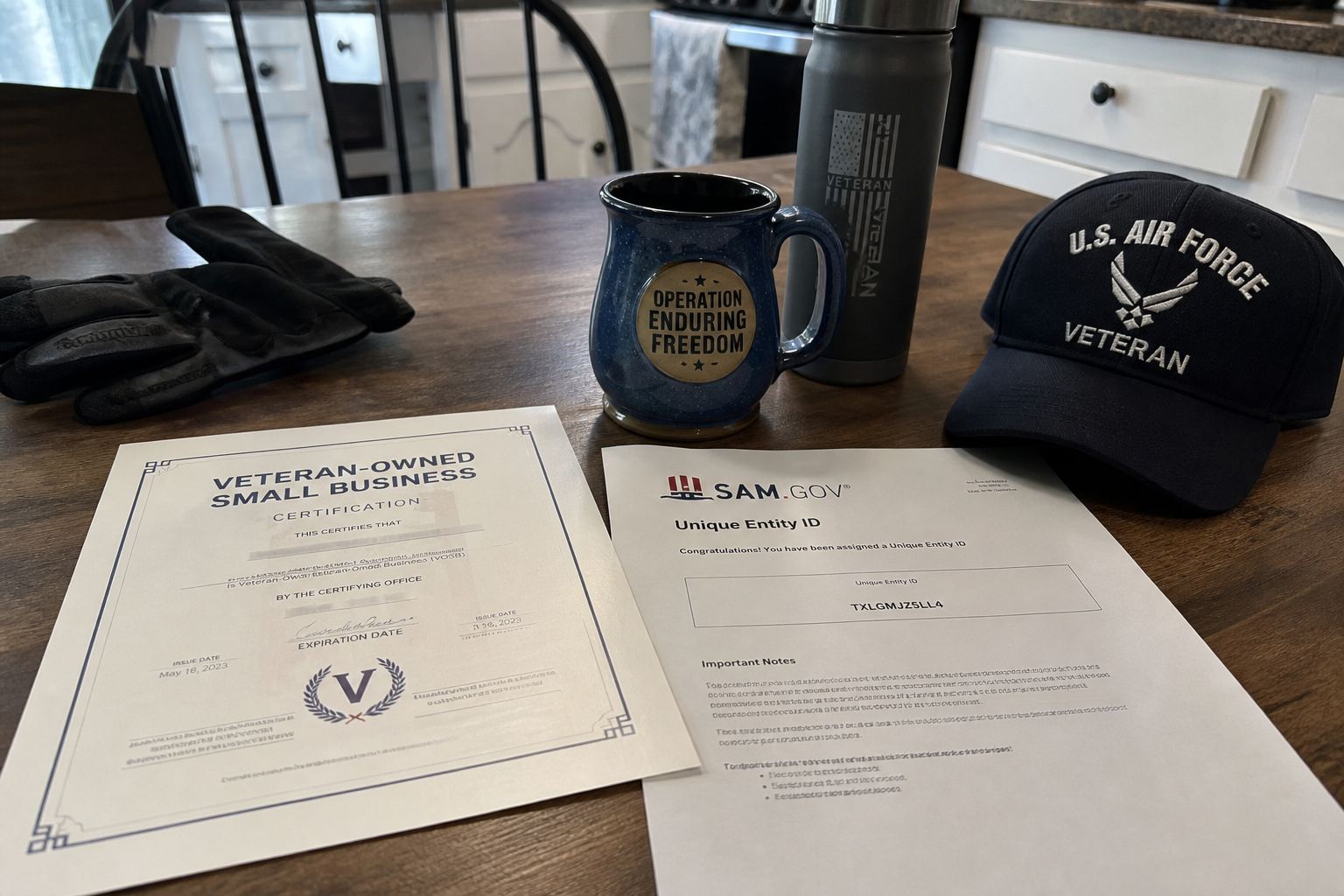
SAM.gov registration and SDVOSB certification are two different things, run through two different systems, and both of them are free, no paid "veteran certification package" needed, no matter what a sales page tells you. Quick disclosure up front: zerogov.net is an independently run site, not SAM.gov, the VA, or any federal agency, so confirm anything that matters directly with SBA or SAM.gov before you rely on it. Finishing SAM.gov registration doesn't automatically flag your business as veteran-owned for set-aside purposes. That status has to be applied for and approved on its own, which is what the rest of this page walks through.
Registration and certification are not the same step
Basic SAM.gov registration gets you a Unique Entity ID, a CAGE code, and a set of self-certifications about your business, including whether you qualify as small under your NAICS code. If you haven't done that part yet, the SAM.gov registration checklist walks through it in order, which matters because the entity validation step is where most people get stuck.
SDVOSB status is a separate layer on top of that. Being a small business doesn't make you a Service-Disabled Veteran-Owned Small Business, even if the founder happens to be a veteran with a service-connected disability. You have to apply for the designation, provide documentation, and get approved. Skipping this step is the single most common reason veteran-owned companies never see the set-aside contracts they assumed they'd qualify for automatically.
What "service-disabled veteran-owned" actually means
To qualify as SDVOSB, a business generally has to be at least 51 percent owned by one or more veterans who have a service-connected disability rating, and those same veterans have to actually control the company's day-to-day management and long-term decisions. Ownership on paper isn't enough if someone else is running the business. This is the same kind of ownership-and-control test used for other SBA programs like 8(a) or WOSB, just applied to a different qualifying group.
SDVOSB versus VOSB: the difference that trips people up
VOSB (Veteran-Owned Small Business, without the disability requirement) and SDVOSB get used interchangeably in casual conversation, and they shouldn't be. SDVOSB is the government-wide set-aside category with real teeth: contracting officers can set aside contracts for SDVOSB competition, and the Rule of Two applies to it the same way it applies to other small business categories, meaning a contracting officer sets work aside for competition when at least two qualified small businesses are expected to bid. That principle survived the 2026 FAR overhaul intact, which you can read about on the FAR overhaul explainer if you want the fuller picture of what did and didn't change.
Plain VOSB status matters most in the context of the VA's own procurement program, which historically has run its own separate verification through the VA rather than through SBA's general certification process. If your main customer is going to be the VA specifically, that distinction is worth confirming directly with the VA's contracting office, since the two certification paths aren't identical and I'd rather send you to the authoritative source than guess at details I'm not fully certain of here.
| SAM.gov registration | SDVOSB certification | |
|---|---|---|
| What it proves | Your business exists, matches IRS and state records, and can legally be paid by the federal government | Your business is majority owned and controlled by one or more service-disabled veterans |
| Who checks it | SAM.gov's entity validation service | SBA's certification program |
| Cost | Free | Free |
| Renewal | Every year | Periodic recertification on a schedule SBA sets, so don't assume it's permanent |
| Do you need it to bid on anything at all | Yes, always | Only if you want access to SDVOSB set-aside or sole-source opportunities |
Where certification actually happens
SDVOSB certification runs through SBA, not through SAM.gov and not through a private firm. There's no fee built into the process itself. You'll submit documentation establishing your veteran status, your disability rating, and proof of ownership and control, and SBA reviews it. If a company is asking you to pay them a flat fee to "get you certified," ask what specifically they're doing that you can't do yourself by filling out the application and submitting the same documents directly. In most cases the honest answer is paperwork assembly, which is useful if your time is tight, but it isn't a certification only they can obtain.
New to contracting? You're not disqualified
Plenty of veterans hesitate because they have no federal past performance history. Contracting officers are allowed to consider related experience, including non-federal work and subcontract experience, when they evaluate a new company. It's a real disadvantage compared to a firm with a decade of federal contract history, but it isn't a locked door, and the SDVOSB set-aside process exists partly because Congress wanted a channel where newer, smaller veteran-owned firms could compete on more even footing rather than head-to-head against established primes. Once you do land your first award, it's also worth understanding how contractor status differs from federal employment in a shutdown, since the protections aren't the same; the page on how a government shutdown affects your contract covers that gap plainly.
A first award also brings employer duties that have nothing to do with your own veteran status. A contract of $200,000 or more means listing your job openings with the state job bank and filing an annual VETS-4212 report on your workforce, whatever your headcount; our page on affirmative action rules for small federal contractors sets out those lines.
One more thing worth saying directly: this site is independent and has no affiliation with SBA, the VA, or SAM.gov, so treat everything here as a starting point and confirm the specifics on the actual certifying agency's site before you submit anything.
Your veteran status doesn't count for anything in federal contracting until it's certified by the right agency. Claiming it on a form is the easy part; getting SBA's approval is what actually opens the door to set-aside contracts.
Independent information, not legal advice. Confirm status and rules on sam.gov and the current FAR text.
Quick answers
- Does veteran status make SAM.gov cost money?
- No.
- Is a website badge enough?
- No. Follow the current official certification path. A logo on a brochure is not the record.
- Do I still need a UEI?
- Yes. Programs sit on top of an active SAM.gov entity.