Independent · not SAM.gov
How long does SAM.gov registration actually take?
Updated September 2026
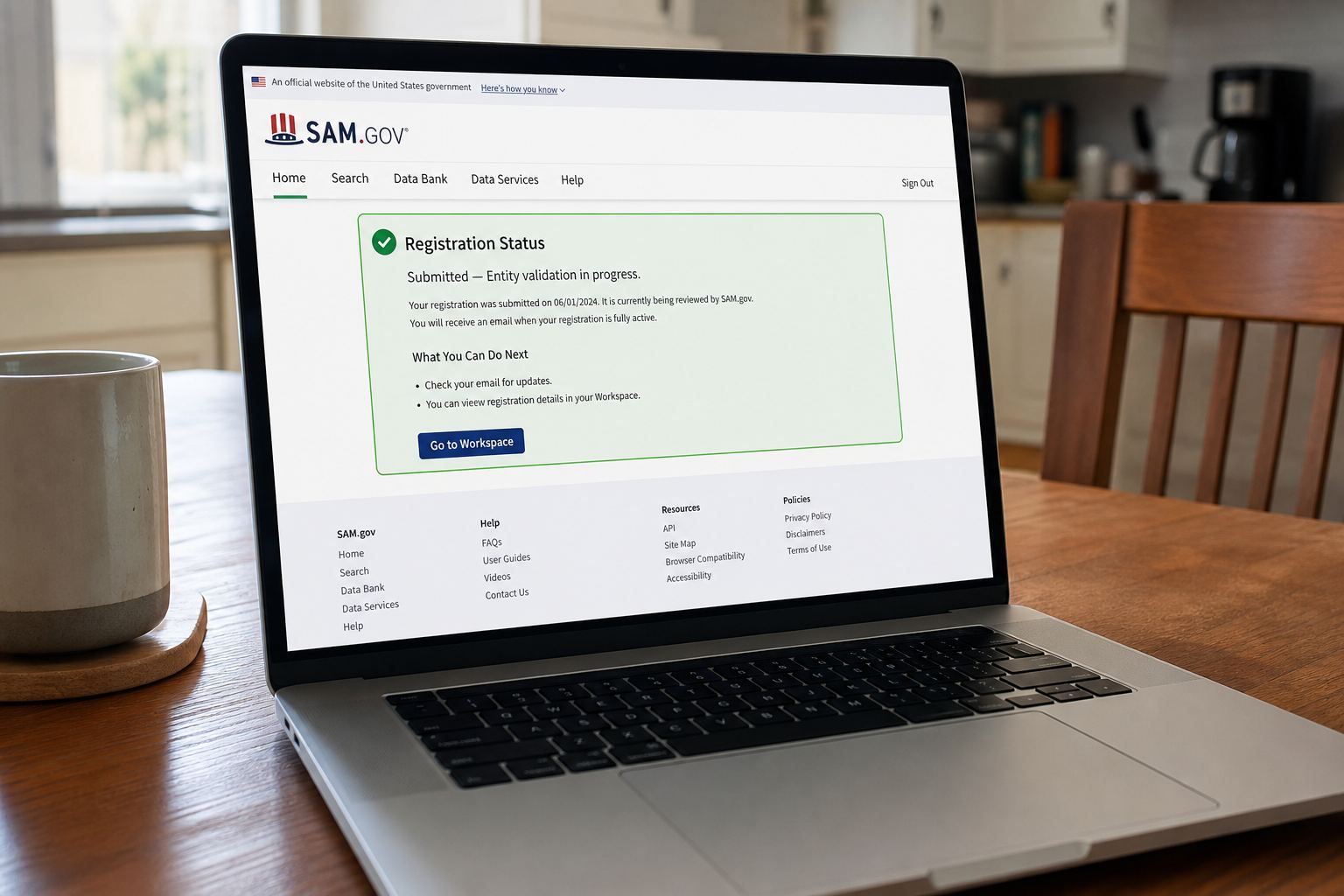
SAM.gov generates your Unique Entity ID, a 12-character code, the instant your entity clears validation, and it retired the old DUNS Number system back in April 2022. Making that ID takes no time at all. Everything before it, the actual registration process, is what takes days, or for some businesses, weeks.
There's no single official number for how long SAM.gov registration takes. Anyone who quotes you a precise average is guessing, or selling something. Worth saying plainly here: zerogov.net is an independent site, not part of SAM.gov or the federal government, so treat this as one contractor's plain-English breakdown, not an agency statement. What's true is that the range is wide. Some businesses clear entity validation in a matter of days. Others sit stuck for weeks on a name mismatch they didn't know existed until SAM.gov flagged it.
What actually decides your timeline
Typing your information into SAM.gov doesn't take long. An hour, maybe two, if you already have your documents ready. The real variable is entity validation, the automated check SAM.gov runs to confirm your legal business name and physical address match what's on file with the IRS and your state.
If that check passes cleanly, you move through the rest of registration, including Reps and Certs (the section where you self-certify things like business size and small business status under your NAICS codes), fairly fast. If it doesn't pass, you're now waiting on a human reviewer to look at whatever document you submitted, and that's where days turn into weeks.
What speeds it up
Having your documents ready before you start is the biggest thing you actually control. That means:
- Your legal business name matches your IRS records exactly, punctuation and abbreviations included.
- You have one document that shows your current legal name and physical address together, not two separate documents that each show half the picture.
- Recurring documents like bank statements or utility bills are less than five years old. Foundational documents like articles of incorporation can be older, as long as the name and address on them still match your current filing.
- Your scan is actually legible. A phone photo of a folded document with a thumb in the corner is a routine reason validation gets kicked back.
If you want to check your own paperwork against this before you start, we built a free SAM.gov registration readiness checklist that saves your progress locally in your browser as you work through it. It's a tool, not a form you submit to anyone, so there's nothing to sign up for and nothing to hand over.
What slows it down
Almost every delay traces back to one of two things: a name that doesn't match, or a document that doesn't prove it does.
| Common issue | Why it stalls you |
|---|---|
| Business name doesn't exactly match IRS records | Triggers an entity validation failure that needs manual review and a corrected document |
| Submitted document shows name or address, but not both together | SAM.gov can't confirm the pairing, so it requests another document |
| Recent legal name change not yet reflected in your state filing | Creates a mismatch between what you typed and what's on record |
| Blurry, cropped, or partial scans | A reviewer can't read what they need to, so the file gets rejected and you resubmit |
None of this is arbitrary. SAM.gov is confirming you're who you say you are before the government can ever pay you, and that check has to be conservative. The frustrating part is how often the actual fix is small, like a missing suite number, or an "LLC" that your state filing spells out as "L.L.C."
Registration is free, and so is fixing a mismatch
Nothing about resolving an entity validation error costs money, because SAM.gov registration itself is completely free, required by law to stay that way. If a service offers to speed up your validation for a fee, be skeptical. Nobody outside SAM.gov's own review queue can make a government reviewer move faster, and the review process doesn't have a paid expedite option, because there isn't one to buy.
Once you're in, remember that registration isn't a one-time task. It has to be renewed every year, and an expired registration makes you ineligible for new contract awards until you renew it, so put the date somewhere you'll actually see it. If you already hold a contract and you're wondering how a funding lapse affects your status separately from renewal, that's a different question with its own rules, covered in our piece on what a government shutdown means for contractors versus employees.
The rules around procurement itself also shifted this year. The 2026 FAR overhaul raised several cost-data and CAS thresholds and renumbered a batch of clauses, though it left small business set-aside protections, including the Rule of Two, intact. None of that changes how SAM.gov validation works, but it's useful context if you're timing a registration around a specific opportunity.
Here's the honest limit of what we can tell you: we don't have a precise, current, publicly reliable average processing time to give you, and we're not going to invent one just to make this page sound more authoritative. It depends heavily on whether your documents clear validation on the first pass, and no source we trust publishes an up-to-date figure for how long that review queue runs at any given moment. If you've been waiting an unusually long time with no update, that's worth raising directly through SAM.gov's own help channels rather than trusting a guessed number here.
Independent information, not legal advice. Confirm status and rules on sam.gov and the current FAR text.
Quick answers
- Is there an official average?
- No. Anyone quoting a precise average is guessing or selling.
- What speeds it up?
- Exact IRS name, one document with name and address, clean scans, Login.gov already done.
- Does paying help?
- Not the validation wait. You still sit in the same government queue.