Independent · not SAM.gov
Do you need a DUNS number, or just a UEI?
Updated September 2026
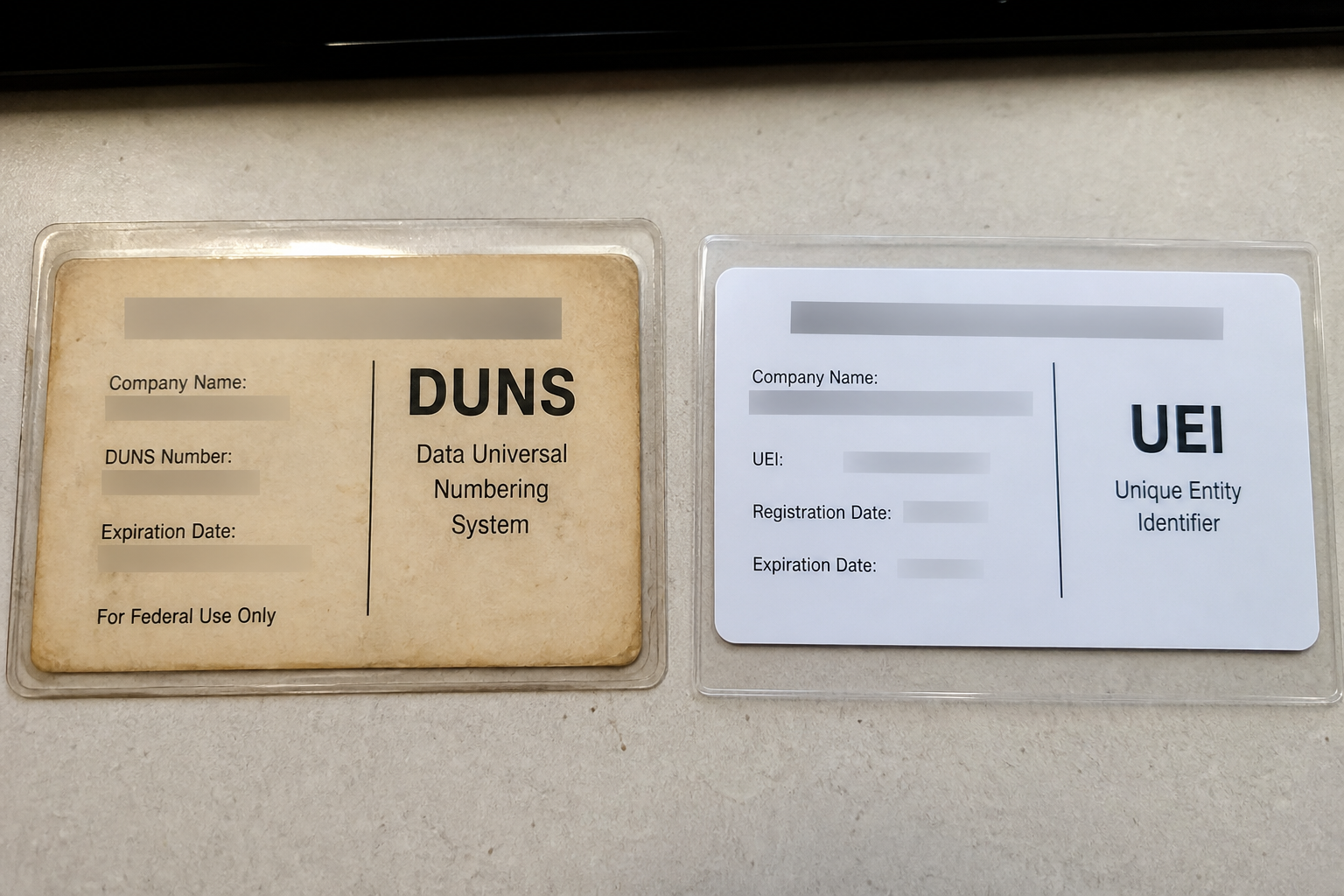
Most pages that mention DUNS numbers and SAM.gov registration in the same sentence get one basic thing wrong: they still treat it as a two-step process, get a DUNS number first, then register in SAM.gov. That process ended years ago. If a guide is telling you to go find a DUNS number before you touch SAM.gov, you're reading something written for a system that doesn't exist anymore. One thing worth saying up front: zerogov.net is a privately run, independent site, not SAM.gov and not any federal agency, so treat everything here as background information rather than official guidance.
The short answer
You do not need a DUNS number. Nobody does, not for federal contracting purposes. SAM.gov retired the DUNS number entirely on April 4, 2022, and replaced it with something called the Unique Entity ID, or UEI. The UEI is a 12-character alphanumeric code, and it's generated automatically, inside SAM.gov, the moment you register or renew your entity. You don't apply for it separately. You don't request it from a third party. It's built into the same free process as everything else on the site.
What actually happened to DUNS
Before 2022, Dun & Bradstreet issued DUNS numbers as a private company, and the federal government used that number as the entity identifier tied to your SAM.gov record. That created an odd arrangement: a government requirement fulfilled by a private vendor's own numbering system, with SAM.gov leaning on it as the anchor for registration.
The government moved away from that setup and brought identifier assignment in-house. As of April 2022, DUNS numbers stopped being used anywhere in federal contracting. If your entity was previously registered under a DUNS number, SAM.gov mapped your record over to a UEI automatically. Nothing on your end had to be requested or purchased to make that switch happen.
Why you still see DUNS mentioned everywhere
Two reasons, mostly. First, plenty of guides, blog posts, and old PDFs from consultants were written before the switch and never got updated. Search engines don't know a page is stale, so four-year-old advice still ranks fine next to current information, and you can't always tell which is which at a glance.
Second, and more cynically, DUNS numbers used to involve a paid step in some contexts, and that created a business model: charge a company money to "obtain" something for them. Some of that language just got recycled once UEI came along, because a confusing-sounding identifier is still an easy thing to build a sales pitch around. If a company is offering to get you a UEI for a fee, they are charging you for something SAM.gov hands you automatically and free the moment you register.
UEI versus CAGE code, since people mix these up too
The other identifier worth knowing is the CAGE code, and it's not the same thing as the UEI, even though both come out of the same registration. Here's the difference.
| Identifier | Status | What it's for | How you get it |
|---|---|---|---|
| DUNS number | Retired since April 2022 | Formerly the entity identifier; no longer used anywhere | Not applicable anymore |
| UEI (Unique Entity ID) | Current, required | Your primary identifier across federal award systems | Generated automatically inside SAM.gov during registration |
| CAGE code | Current, required | A 5-character code used mainly for logistics and contracting identification | Assigned as part of the same SAM.gov registration |
Notice that both current identifiers come from the same place: the registration itself. You're not filling out three separate applications. You're filling out one, and SAM.gov issues both codes as part of it.
What this means for your registration
If you're starting a new SAM.gov registration today, you will never see a field asking for a DUNS number. You'll get your UEI as part of the registration flow, no separate steps, no separate fee. The parts of registration that actually cause delays tend to be the entity validation step, where your legal name and address have to match IRS and state records, and the representations and certifications section where you self-certify your business size and status. Those are the places worth spending your attention, not an identifier that hasn't existed for years. Our SAM.gov registration checklist walks through the whole sequence in order, including where entity validation tends to trip people up, and it saves your progress locally so you're not redoing work if you get interrupted partway through.
The identifier system is one of the few things the 2026 FAR overhaul left completely alone. It touched thresholds, clause numbering, and set-aside procedures, all covered in our plain-English rundown of the FAR overhaul, but UEI and CAGE assignment work the same as they did before the overhaul took effect. And none of this changes if the government shuts down partway through your registration or renewal window either; that's a separate set of concerns covered in our piece on what a shutdown does and doesn't do to your contract, worth a read if you're timing a registration near a funding deadline.
None of this is official guidance, by the way. Zerogov.net isn't the government and isn't SAM.gov, just a small business that got tired of watching paid registration services quietly bill people for a step that takes SAM.gov itself about as long as it takes to fill out a form. Somewhere out there, a company is probably still charging several hundred dollars to "handle your DUNS number" for an identifier that stopped existing years ago, and they will likely keep finding customers for it right up until the day the whole industry runs out of small business owners who haven't checked.
Independent information, not legal advice. Confirm status and rules on sam.gov and the current FAR text.
Quick answers
- Do I buy a UEI?
- No. It is generated in SAM.gov after you register.
- Is DUNS still used for federal contracts?
- Not since April 2022. Old guides that start with DUNS are stale.
- Is a UEI the same as a CAGE code?
- No. Different identifiers. Both come with a successful SAM.gov registration.